
Product Strategy: Complete Guide + AI-Ready Template
A Product Strategy defines where you’re going, why it matters, and what you will (and won’t) focus on to get there.
When done well, strategy aligns product, leadership, and cross-functional teams around clear choices — not just goals or roadmaps.
This guide covers:
What product strategy is (and isn’t)
When you actually need a strategy document
What makes a strong product strategy in modern teams
How AI changes the way strategy should be written
A free, public AI-ready Product Strategy template you can use today
If you’re looking for a practical, focused alternative to bloated corporate strategy decks — you’re in the right place.
What Is Product Strategy?
Product strategy is the set of deliberate choices that determine:
Who you serve
What problems you commit to owning
How you will win
What you will not prioritize
It connects high-level company vision to real product execution.
A strong product strategy answers five core questions:
Why is change necessary now?
What future state are we working toward?
What choices will we make to get there?
What initiatives will drive progress?
What assumptions and risks could invalidate this plan?
Contrary to common belief, product strategy is not:
A roadmap
A list of features
A vision slogan
A quarterly OKR document
A 40-page corporate presentation
Those artifacts may exist — but strategy is about direction and choice, not slides.
Do You Need a Product Strategy Document?
You likely need one if:
You lead a product team or product line
Multiple squads depend on shared direction
You’re entering a new market or changing focus
Leadership alignment is unclear
Roadmap debates keep resurfacing the same disagreements
You may not need one if:
You’re a single founder building the first version
The product direction is already crystal clear
You’re making minor, incremental improvements
The goal is not documentation for documentation’s sake.
The goal is clarity before committing time, talent, and capital.
What Makes a Strong Product Strategy (Modern Edition)
Strong product strategies today share a few key characteristics:
1. Grounded in Customer and Market Reality
Great strategies start with context:
Customer pain
Market shifts
Competitive pressure
Internal performance signals
If the “Why” isn’t evidence-based, the strategy is fragile.
2. Clear Vision — Not Just Ambition
A strong strategy includes a concise vision statement:
1–3 sentences
Clear future state
Understandable to the entire company
Not:
A vague aspiration
A list of metrics
A collection of buzzwords
Vision provides direction. Strategy provides focus.
3. Explicit Strategic Choices
Strategy is choice.
Strong strategy documents clearly define:
Who we serve
What we will own
How we win
What we will not do
Without tradeoffs, you don’t have strategy — you have a wish list.
4. Focused Initiatives
Strategy translates into a small number of high-leverage initiatives.
Not:
20 parallel bets
A backlog rebranded as strategy
Tactical feature lists
A strong strategy concentrates resources.
5. Risks and Assumptions Are Visible
Modern product leaders make uncertainty explicit:
What must be true for this to work?
What risks could derail it?
What signals would force a pivot?
If risks are hidden, strategy becomes storytelling.
How AI Changes Product Strategy
AI tools are increasingly used for:
Market research synthesis
Scenario modeling
Roadmap simulation
Competitive analysis
Initiative ideation
But AI is only as strong as the context it receives.
That’s why modern strategy documents must:
Clearly define the target segment
Articulate core problems
Make tradeoffs explicit
State assumptions and constraints
Define measurable objectives
Without structure, AI produces generic answers.
With clear strategic framing, AI becomes a powerful thought partner.
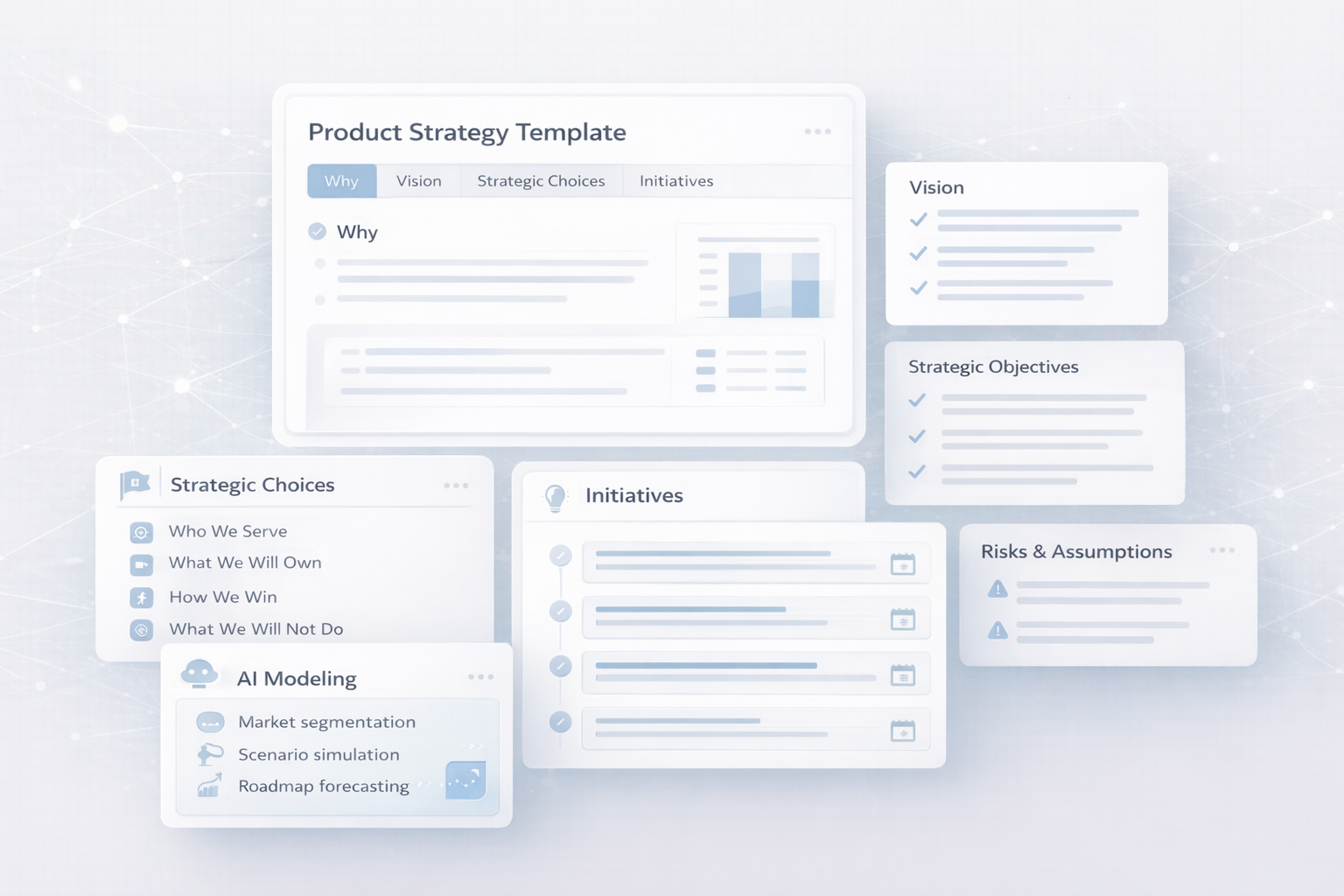
The AI-Ready Product Strategy Template
I created this free Product Strategy template to work for both humans and AI tools.
What makes this template different
Clean and lightweight at first glance
Optional, expandable guidance under each section
Strong emphasis on strategic choices and tradeoffs
Clear separation between vision, objectives, and initiatives
Explicit risks and assumptions
Structured so AI tools can reason about direction and constraints
What’s included in the template
Why (context and strategic rationale)
Vision (with 12–18 month strategic objectives)
Strategic Choices
Who We Serve
What We Will Own
How We Win
What We Will Not Do
Key Strategic Initiatives
Risks & Assumptions
Each section includes guidance explaining:
Why it exists
What to include
What good looks like
Common pitfalls to avoid
How to Use the Template
New to strategy?
Open the guidance toggles as you write — they’re there to coach you.
Experienced product leader?
Ignore the guidance and focus on clarity.
Using AI tools?
Make sure your Why, Vision, Strategic Choices, Initiatives, and Assumptions are clearly articulated. That structure is what enables high-quality AI reasoning.
The template is intentionally opinionated — but flexible enough to adapt to different products and teams.
When This Template Works Best
This Product Strategy template works especially well for:
Startup product teams
Directors or VPs overseeing multiple product lines
B2B SaaS platforms
Ecommerce or marketplace products
Teams experimenting with AI-assisted planning
It’s less suited for:
Corporate board decks
Investor pitch documents
Highly regulated enterprise compliance strategies
Final Thoughts
Product strategy is not about writing a document.
It’s about making clear, defensible choices.
When done well, a strong strategy:
Aligns teams
Reduces roadmap conflict
Forces focus
Surfaces risk early
Increases the odds of meaningful impact
If you want a Product Strategy template that reflects how modern product teams operate — and how AI is changing strategic work — this one is built for that.
Get the AI-Ready Product Strategy Template
Make clear strategic choices that align your team and drive meaningful impact. This free Notion template includes built-in guidance for vision, strategic choices, initiatives, and risks.
Download Template →